 From Markup to Markdown
Explore the history of technical writing with this exciting new book, available now!
From Markup to Markdown is about how we’ve used computers for writing. It explores several milestones in using computers to write.
In the book, I start with RUNOFF, which inspired so many other document markup systems after it. One notable system was roff, at Bell Labs. There’s a great story about that in the book, but the short version is roff became new roff (called nroff) so Bell Labs could write patent applications. Later, they changed it to troff (or typesetter roff) to support using a phototypesetter.
I also wrote about TeX and LaTeX, and desktop writing tools like word processors and dot matrix printers. The book also explores modern markup systems too, like HTML and DITA. DITA is an XML-based markup system that helps technical writers solve the problem of content reuse. The last chapter in From Markup to Markdown has a brief introduction to how you can use DITA.
Every chapter has tons of examples that show you how to use each system to create documents. I also walk the reader through some sample source code so you can see how these systems worked “behind the scenes.” (But I kept it pretty simple; you don’t have to know anything about programming to understand the code.)
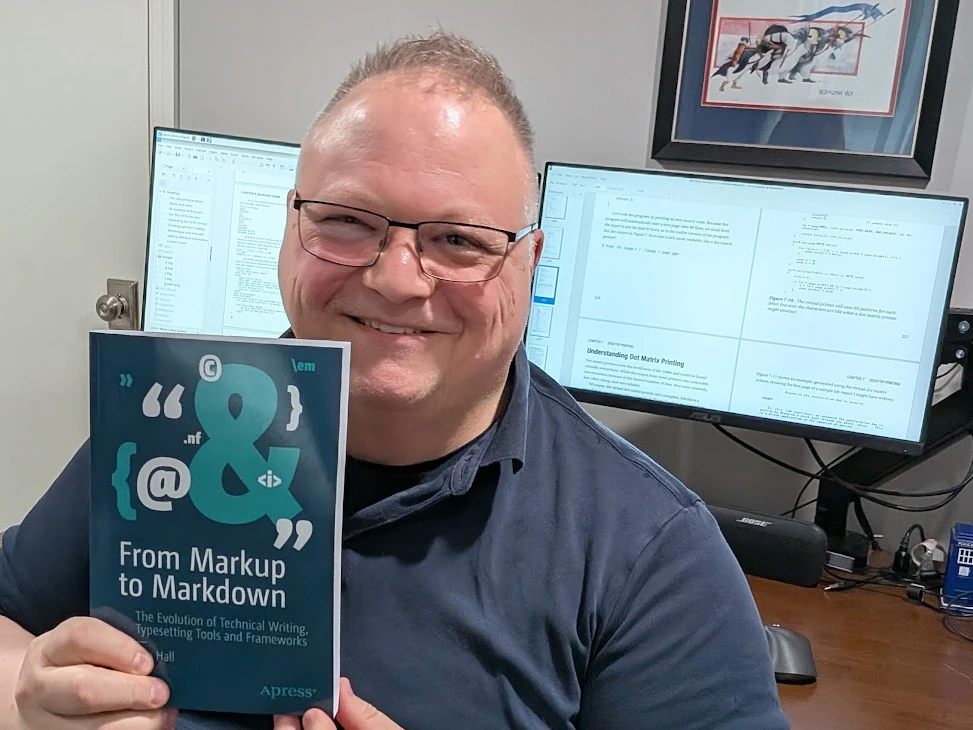
My favorite markup
I have so many favorite parts of this book, so it’s hard to pick just one. It depends on what I’m working on, but I always find a spark of joy by writing in troff. This is implemented as GNU groff on Linux systems, and the groff developers have done an outstanding job with it.
That’s how I got started with document preparation, before I learned other markup and writing tools. When I was an undergraduate, I used the -me macros by Eric Allman for writing class papers that only needed paragraphs and quotes. These days, I like using the Bell Labs -ms macros. I actually wrote a (personal) book project last year using groff, including equations and diagrams.
Why I love markup
I wrote From Markup to Markdown because I’ve always loved document markup systems and I wanted to write more about how to use them.
My first document markup system was nroff, which I learned when I was an undergraduate physics student at university. I write more about this in the book, but using nroff let me take advantage of a “loophole” in the computer lab policy: they charged you to print to the laser printer, but printing to the dot matrix printer was free as long as you didn’t cause a problem.
After that, I learned other markup systems, like LaTeX, which made it really easy to write lab reports for my physics classes, which required equations so you could show how you analyzed the data. Later, I taught myself to format documents in the then-new Hyper Text Markup Language, or HTML. Things continued from there.
Today, I also teach technical writing at a university; one of my favorite classes is about using different tools for writing. And with that background, I often write articles that look back on the history of technical writing, especially how we’ve used computers for writing. That was my starting point for the book, I wanted to do a “deep dive” into these important milestones in using computers to write documents.
Buy the book
From Markup to Markdown is on sale now! Buy it from Springer/Apress, at Amazon, at Barnes & Noble, or wherever you buy books.
- Explore the history of technical writing in the age of the personal computer, from the 1960s to the present day
- Understand how key writing technologies and tools have evolved over time
- Full of practical code examples from RUNOFF, dot matrix printing, and Markdown

Jim Hall is an open source software developer and technical writer, including projects such as open source usability and the FreeDOS Project. At work, Jim is CEO of Hallmentum, an IT executive consulting company. | Check out Jim's new book From Markup to Markdown (available now) about important milestones in writing with computers, including nroff, LaTeX, HTML, and DITA.