 A look back: Mergenthaler Linotron 202
How phototypesetters produced professionally-formatted documents
You may be familiar with the nroff document preparation system. Developed at Bell Labs, and inspired by Jerry Saltzer’s RUNOFF, the Unix nroff system produced professionally-formatted output. However, it was limited by the printing method of the day: a TeleType Model 37 or another similar printing terminal that produced typewriter-like output.
In 1973, the Unix team at Bell Labs purchased their first phototypesetter: a Graphics Systems C/A/T phototypesetter. This supported different fonts, which were loaded using film strips in a special drum. Using a phototypesetter was a huge improvement to how documents had been prepared previously at Bell Labs. Joe Ossanna (Unix team) updated the nroff system to support the new C/A/T phototypesetter, turning nroff (new roff) into troff (typesetter roff). The C/A/T saw heavy use by the Unix team to write technical articles, and the Patents team to produce patent applications.
By 1979, the C/A/T phototypesetter was showing its age, and the Unix team successfully advocated to purchase a new phototypesetter. In the summer of 1979, Bell Labs purchased a new Mergenthaler Linotron 202, a CRT-based phototypesetter.
Unfortunately, Joe Condon, Brian Kernighan, and Ken Thompson (all from the Unix team at Bell Labs) experienced a cascade of problems with the new device, and spent the summer resolving issues with the 202. The Unix team documented their efforts with the 202 in a memo titled “Experience with the Mergenthaler Linotron Phototypesetter, or, How We Spent Our Summer Vacation,” meant to be published internally in January 1980.
Ultimately, the technical memo was never published, by request from Bell Labs management. Brian Kernighan notes on his web page about Digital restoration and typesetter forensics that the document was blocked probably on valid grounds that it might be revealing someone else's proprietary information.
The 202 memo has a section titled “Reverse Engineering” (p. 6) that notes In parallel with our efforts at making the device work at all, we spent quite a bit of time trying to figure out how it works, and what the character set encoding is.
The section is quite interesting to understand the inner workings of a phototypesetter at the time.
In basic terms, the 202 loaded digital fonts, and could display that text at various sizes on a CRT. The 202 also supported graphics, the phototypesetter could also produce other kinds of elements, including line drawing. When the 202 had rendered a page to the screen, it passed photosensitive paper over the CRT and exposed it to the light emitted by the screen, leaving a photographic imprint on the paper. The paper was then processed like film to produce camera-ready output.
Through some clever coding and inspection, Condon, Kernighan, and Thompson eventually figured out how the 202 loaded its font data. As documented in the memo, Characters are represented by vectors that, taken in the proper order, define the lower and upper limits of inked areas as the hardware steps across the character definition from left to right.
In other words, the 202 fonts were essentially outlines defined by short lines; the closed interior was then filled in. This was an effective way to represent letter forms if they did not get too big.
Probably a good way to demonstrate this is to make a simple diagram as an SVG that just jumps to points to describe a letter. Let’s look at the lowercase letter e, which I’ve drawn rather crudely as a series of straight lines. When rendered at smaller sizes, the letter looks normal. (Not too bad for a simple drawing.) But when displayed in larger sizes, you can start to see the straight lines. The “line segment” model works fine for everyday font sizes, as long as you don't get too big.
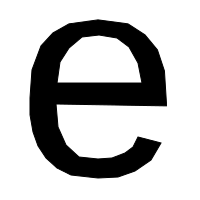
This is essentially how the 202 produced letter forms. And once the Bell Labs team figured out how the 202 stored the font data, they could generate their own custom fonts, such as the Bell System logo.
Several years ago, Dave Brailsford, Steve Bagley, and Brian Kernighan reconstructed the 202 memo. In this Computerphile video from 2013, Brailsford explains how the 202 was reverse engineered at Bell Labs. As explained in the video, the 202 project served as a precursor to the democratization of digital typography and high-quality printing, showcasing an early triumph of software engineering and reverse engineering.

Technically We Write is a community of technical writers, technical editors, copyeditors, web content writers, and all other roles in technical communication. We'd love to share your story! Contact our editors to share your article idea.